


II. Plastics: An inconvenient truth
- mindtheeco

- Mar 22, 2021
- 4 min read
Updated: Apr 28, 2021
Now that you know what plastics are made of and how they became so popular, let's dive into their inconvenient truth.
Did you know that by 2015 the world's cumulative plastic production was more than 7.8 billion tonnes? Just imagine: this is the equivalent to more than 1.4 billion elephants.
Why do we produce so much plastic?
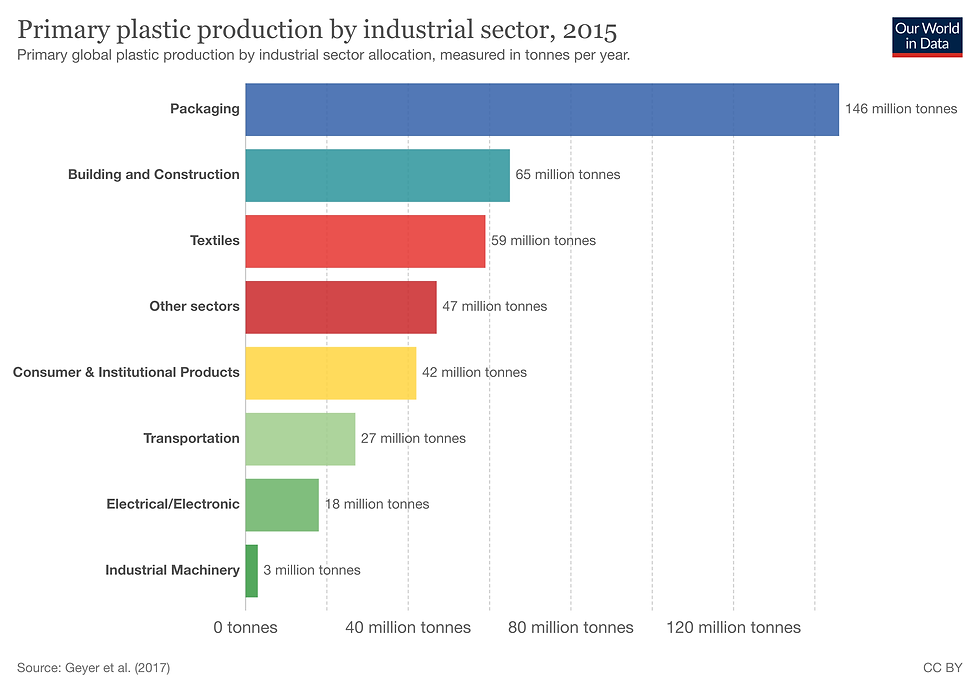
As we know by now, plastic is a high quality, versatile and cheap material, and it is used in almost every industrial sector. Plastics go way beyond packaging, they are in our clothes, cars, buildings and much more. Did you know that 60% of our clothing materials is plastic? Textiles represent 35% of the microplastics that enter the ocean. We produce so much plastics because this material is used everywhere, with each industry producing more than millions of tonnes per year.
Why is producing a huge amount of plastic so problematic?

Well, plastics have a long afterlife. Plastic water bottles, for instance, can take up to 450 years to decompose. Most likely, the majority of plastic you consume throughout your life will long outlive you.
Food for thought: If plastic is meant to last forever, why is it part of so many single-use items?
Now, you might be thinking to yourself: "But at least plastic is recyclable, no?"
Unfortunately, just because some plastics are recyclable doesn't mean they will actually be recycled. In fact, only 9% of the total plastic waste produced from 1950 until 2015 has been recycled. As of 2015, the global recycling rate was only 20%. Plastic's life does not end once we throw them in the trash.
And there is more…
The majority of plastics can only be recycled at most three times. Thus, "recycling delays, rather than avoids, final disposal" (Geyer et al. 2017).
Okay, so we produce way too much plastic, recycle way too little and even after we recycle a couple of times, it will just be disposed, lasting for years to come. Can it get any worse?
In case you didn't know, most plastics come from fossil fuel. Plastic production contributes to climate change. From extraction to disposal, plastics produce greenhouse gases. Research has also shown that plastic in the ocean can interfere in the metabolism of phytoplankton and zooplankton, who are responsible for sequestering CO2. This reduces the ocean's ability to absorb gases.
What about the plastic that is not recycled, not incinerated nor disposed in landfills?
Unfortunately, the natural environment is a common destination of our plastic waste. If plastic production and disposal continue at predicted rates, by 2050, we could have more plastics in the ocean than fish stocks. Have you heard of the Great Pacific Garbage Patch? It is an accumulation of litter in the North Pacific Ocean, of which 99.9% represents plastic. Out of this 99.9%, 52% comes from fishing activity, including fishing lines, nets and ropes.

Most likely, you have already seen those pictures of animals who digested or got entangled in plastics. Have you wondered if this could be happening to us, humans?
Well, we might also be eating and breathing plastics. One third of all plastic waste ends up in soils and freshwater. When in the environment, plastics decompose into microplastics*. These microplastics have been found in the air, our food, drinks and recently in a human placenta. It is still unknown the impact microplastics will have in human health in the long term.
*Read more:
Four toxic effects produced by microplastics:
Its interaction with soil can affect fauna's health and soil functions
During decomposition stage, additives known to disrupt the hormone system of vertebrates, and several invertebrates leach out of plastic particles
Nano-sized particles may cause inflammation, trigger changes in gene expression and biochemical reactions
Microplastic surfaces may carry and transmit disease-causing organisms
Lastly, I would like to remind us of an important issue that is often overlooked when it comes to the plastic crisis:
The plastic crisis is also a matter of environmental justice. Most plastic waste is shipped to poorer countries that have less strict waste management policies. In addition, low-income BIPOC communities are more likely to live near landfills and incineration plants where a lot of the plastic waste will end up.
Do you see a lot of plastic in the environment where you live? Comment below!
You might be thinking to yourself: "It's okay, we just need to increase our recycling rates".
Well, I now invite you to go to our next post in the plastic journey. It's time to explore the myth of recycling.
Did you enjoy our content? Consider supporting Mind the Eco: Buy me a coffee ☕️
Sources:
Ritchie, H. (2018, September 1). Plastic Pollution. Our World in Data. https://ourworldindata.org/plastic-pollution
WWF-Australia. (2018, June 19). The lifecycle of plastics. https://www.wwf.org.au/news/blogs/the-lifecycle-of-plastics#gs.vtb0j5
Kaufman, H. (2020, March 25). Why plastics are also a climate issue | Greenbiz. GreenBiz. https://www.greenbiz.com/article/why-plastics-are-also-climate-issue
Kaplan, S. (2016, January 20). By 2050, there will be more plastic than fish in the world’s oceans, study says. Washington Post. https://www.washingtonpost.com/news/morning-mix/wp/2016/01/20/by-2050-there-will-be-more-plastic-than-fish-in-the-worlds-oceans-study-says/
Plastic planet: How tiny plastic particles are polluting our soil. (2018, April 3). UN Environment. https://www.unep.org/news-and-stories/story/plastic-planet-how-tiny-plastic-particles-are-polluting-our-soil
Forschungsverbund Berlin e.V. (FVB). (2018, February 5). Land-based pollution with microplastics an underestimated threat. PHYS.ORG. https://phys.org/news/2018-02-land-based-pollution-microplastics-underestimated-threat.html
Koumoundouros, T. (2021, February 21). We Need Urgent Research to Know What Microplastics Are Doing to Us. Here’s Why. ScienceAlert. https://www.sciencealert.com/toxicologists-urge-for-research-into-the-unknown-health-risks-of-microplastic
Comments